
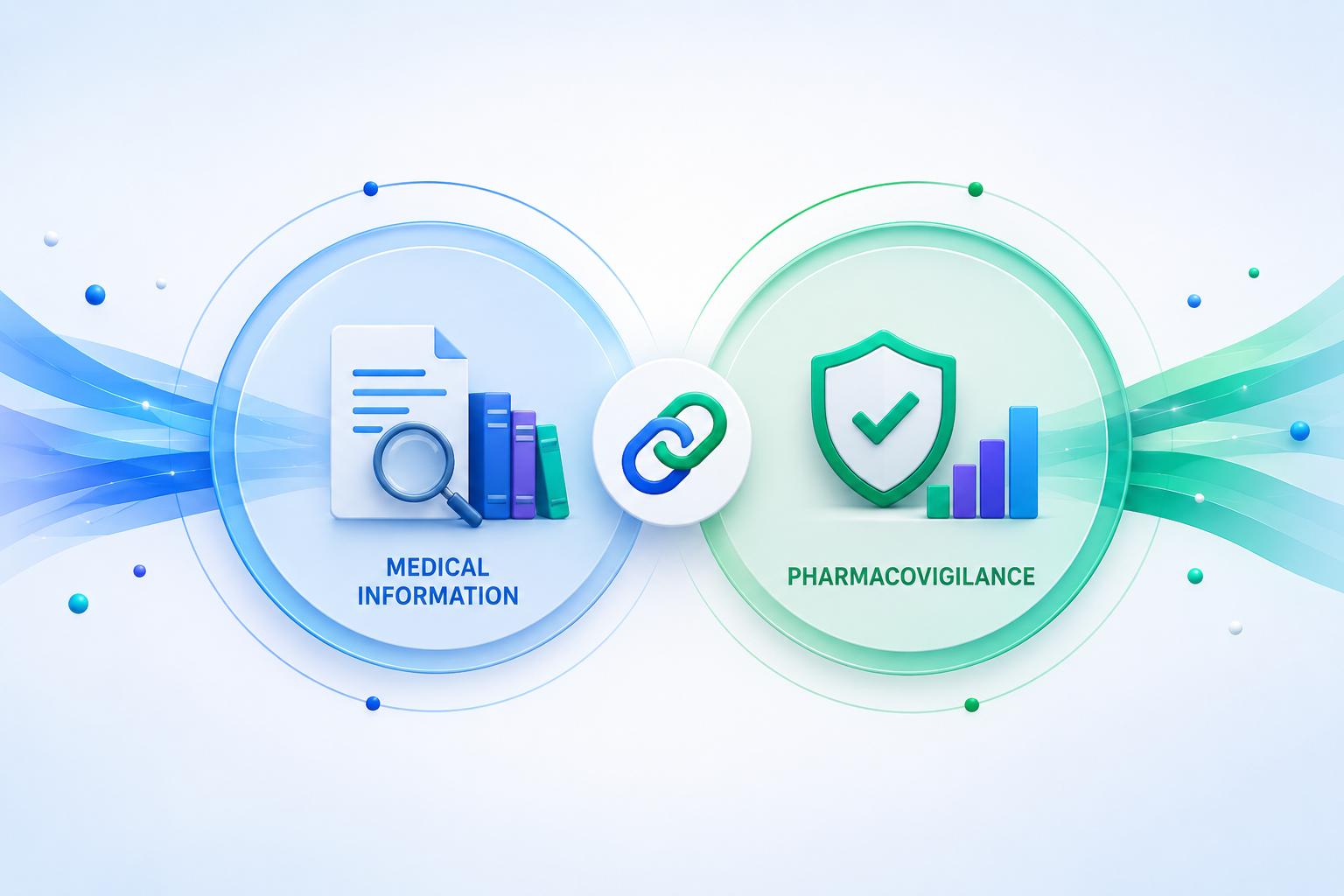
In the pharmaceutical sector, Medical Information and Pharmacovigilance represent two distinct yet closely interconnected functions. Although they have different responsibilities and processes, they share a central objective: protecting patient health through the rigorous, timely, and transparent management of information on medicinal products.
Collaboration between these functions is essential to ensure high-quality information, regulatory compliance, and the appropriate and safe use of medicines.
Two functions, two complementary roles
Although both functions manage information related to medicinal products, Medical Information and Pharmacovigilance have different objectives.
Medical Information is responsible for providing accurate, balanced, and up-to-date scientific information on pharmaceutical products by responding to specific inquiries and contributing to a proper understanding of their use. Pharmacovigilance, on the other hand, focuses on the continuous monitoring of drug safety through the collection and analysis of safety data and suspected adverse reactions.
Operational processes and regulatory requirements also differ, but they require constant coordination in areas of overlap.
Points of interaction
One of the main points of interaction between Medical Information and Pharmacovigilance arises when a medical-scientific inquiry includes information that is also relevant to drug safety.
For example, a healthcare professional may request clarification on dosage or administration and, while describing the case, report a suspected adverse reaction. In other cases, the inquiry may reveal information about off-label use, medication errors, lack of efficacy, exposure during pregnancy or breastfeeding, overdose, or misuse of the medicinal product.
The importance of an integrated approach
In practice, coordination between Medical Information and Pharmacovigilance translates into concrete activities: those managing the initial contact must be able to promptly identify a suspected adverse reaction emerging from an information request; the collected information must be transferred to pharmacovigilance in accordance with defined procedures and timelines; moreover, staff must be trained to recognize all cases potentially relevant to safety, even when they do not initially appear as spontaneous reports.
Shared procedures, targeted training, and clearly defined responsibilities help prevent omissions and delays in case handling.
The completeness of the information collected during the initial contact and the timeliness with which it is forwarded directly impact the effectiveness of safety monitoring.
Data reconciliation between Medical Information and Pharmacovigilance
Another important aspect of coordination between Medical Information and Pharmacovigilance concerns data reconciliation processes. These processes aim to ensure that information potentially relevant to patient safety is consistent and complete across all involved systems.
In practice, this involves periodically comparing the information collected by the two functions to verify that all suspected adverse reactions identified through Medical Information activities have been properly transmitted to and taken in charge by Pharmacovigilance.
This cross-checking activity helps identify and resolve any discrepancies, contributing to reducing the risk of underreporting and improving the overall quality of safety data. In this way, reconciliation represents a key element in ensuring the traceability and integrity of information throughout its management lifecycle.
Conclusions
Medical Information and Pharmacovigilance perform different but complementary roles within the pharmaceutical system.
Their coordination allows for the provision of reliable scientific information while also ensuring the correct identification and management of data relevant to the monitoring of drug safety.
An integrated and well-structured approach therefore remains essential to combine information quality, regulatory compliance, and the protection of public health.
References
- EMA – Good Pharmacovigilance Practices (GVP)
- EFPIA – Guideline on Medical Information
- IFPMA – Code of Practice 2024