
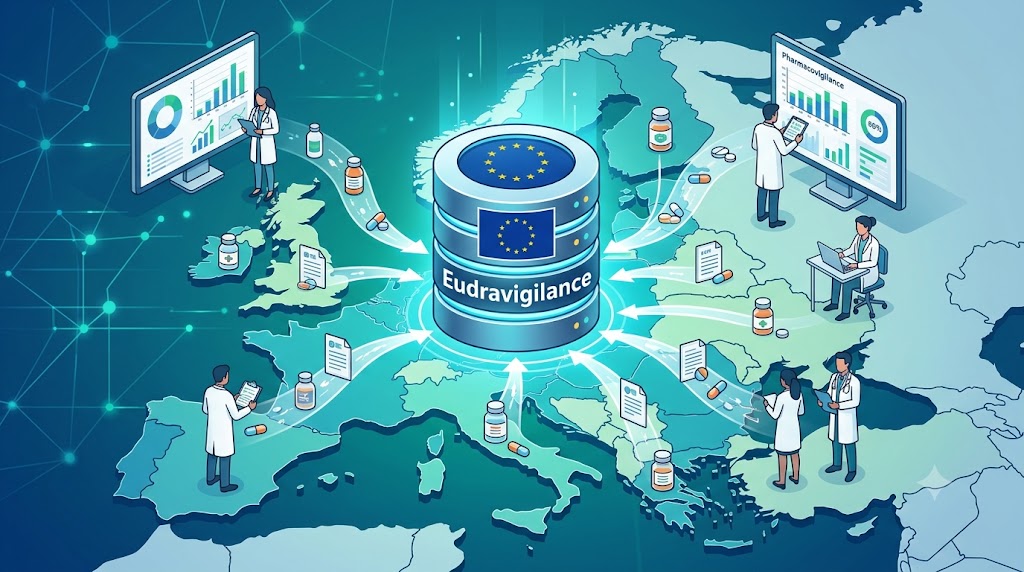
Within the European pharmacovigilance system, EudraVigilance serves as the central IT platform for collecting, managing, and analyzing reports of suspected adverse drug reactions.
Managed by the European Medicines Agency (EMA) on behalf of the European Union regulatory network, the system enables competent authorities, pharmaceutical companies, and clinical trial sponsors to share safety information in a structured and harmonized manner.
Rather than being a simple database, EudraVigilance is an operational system that supports the continuous monitoring of the benefit-risk profile of medicinal products. In addition, it helps identify potential safety signals at an early stage and supports regulatory decisions aimed at protecting patients.
What is EudraVigilance and what is its purpose?
EudraVigilance is the European system for managing and analyzing information on suspected adverse reactions associated with medicines that are either authorized or under clinical development within the European Economic Area (EEA). The system collects Individual Case Safety Reports (ICSRs), which are structured reports describing a single case of a suspected adverse reaction.
Information may originate from several sources, including spontaneous reports submitted by healthcare professionals, patients, and pharmaceutical companies, as well as post-authorization studies, scientific literature, patient support programs, and, for investigational medicines, reports of suspected unexpected serious adverse reactions identified during clinical trials.
The primary purpose of EudraVigilance is to provide standardized and comparable safety data across Europe. As a result, reports can be analyzed collectively to identify unexpected increases in specific adverse events and determine whether further investigations or risk minimization measures may be required.
Who uses EudraVigilance and for what purposes?
Several stakeholders within the European pharmacovigilance system use EudraVigilance. These include the EMA, national competent authorities across the EEA, Marketing Authorisation Holders (MAHs), and clinical trial sponsors. Each stakeholder interacts with the system according to responsibilities and obligations established by European legislation.
For pharmaceutical companies and sponsors, EudraVigilance serves as the electronic gateway for submitting reports of suspected adverse reactions. In the cases required by legislation, the electronic submission of ICSRs is mandatory and allows safety data to be automatically shared with relevant regulatory authorities.
For regulatory agencies, on the other hand, EudraVigilance functions as a surveillance and analytical tool. Through EudraVigilance and EVDAS (EudraVigilance Data Analysis System), authorities can query data, monitor reporting trends, and support activities related to the identification, validation, and evaluation of safety signals.
A practical example helps illustrate the process. If a pharmaceutical company receives a report of a suspected adverse reaction associated with a medicinal product, the case is assessed, coded according to applicable standards, and transmitted to EudraVigilance. Once submitted, the report becomes part of the European database and can be analyzed alongside similar cases. This allows authorities to determine whether the reported event represents an isolated occurrence or a potential safety signal requiring further investigation.
The role of EudraVigilance in pharmacovigilance activities
EudraVigilance is integrated into the main pharmacovigilance processes, from adverse event reporting to aggregated data analysis. Its value does not lie in individual reports considered in isolation, but rather in the ability to compare and assess large volumes of information originating from different countries and sources.
The data contained in the system are used for the continuous monitoring of medicinal product safety and for evaluating the benefit-risk balance throughout a product’s lifecycle. In particular, EudraVigilance plays a key role in signal detection, which involves identifying new or unexpected information that may indicate a potential risk associated with a medicinal product and therefore requires further scientific assessment.
For example, a pharmacovigilance team may analyze data within EVDAS to determine whether a particular adverse event is being reported more frequently than expected or more frequently than during previous reporting periods. If a potential signal is identified, this does not automatically imply a causal relationship between the medicine and the event. Instead, it triggers a broader evaluation that includes spontaneous reports, clinical data, scientific literature, and epidemiological evidence.
It is important to note that the reports contained in EudraVigilance refer to suspected adverse reactions. They indicate that an event was observed following the use of a medicinal product, but they do not by themselves prove causality. Consequently, interpreting these data requires scientific expertise, appropriate analytical methodologies, and comparison with additional sources of evidence.
Regulatory Framework
The use of EudraVigilance is governed by the European regulatory framework for the pharmacovigilance of medicinal products for human use. This framework establishes the obligations for collecting, reporting, analyzing, and evaluating safety information by competent authorities, Marketing Authorisation Holders, and clinical trial sponsors.
Key regulatory references include Directive 2001/83/EC, which establishes the Community code relating to medicinal products for human use, and Regulation (EC) No 726/2004, which defines the EU procedures for the authorization and supervision of medicinal products and establishes the EMA.
These regulations are complemented by the Good Pharmacovigilance Practices (GVP), particularly Module VI, which addresses the collection and reporting of suspected adverse reactions, and Module IX, which focuses on signal management.
Together, these regulations and guidelines establish EudraVigilance as an essential component of a coordinated, traceable, and harmonized European system for monitoring medicinal product safety.
Conclusions
EudraVigilance is a cornerstone of European pharmacovigilance because it enables the standardized collection, sharing, and analysis of information on suspected adverse drug reactions.
Through centralized data management and advanced analytical tools, the system supports the early identification of potential risks, the scientific evaluation of safety signals, and the implementation of appropriate regulatory actions when necessary.
In this sense, EudraVigilance is much more than a database. It is a shared infrastructure that transforms individual safety reports into meaningful knowledge, supporting public health protection and promoting the safe and effective use of medicines.
References
- European Medicines Agency (EMA) – EudraVigilance: system description, objectives, and stakeholders involved in the electronic transmission of Individual Case Safety Reports.
- European Medicines Agency (EMA) – EudraVigilance System Overview: system components, including EV Gateway, EVWEB, and safety data management and analysis functions.
- Italian Medicines Agency (AIFA) – European EudraVigilance System: description of system functionality and integration with the National Pharmacovigilance Network.
- European Database of Suspected Adverse Drug Reaction Reports (eu): public portal providing access to aggregated safety data and guidance on report interpretation.
- Directive 2001/83/EC of the European Parliament and of the Council on the Community code relating to medicinal products for human use, as amended.
- Regulation (EC) No 726/2004 of the European Parliament and of the Council on Union procedures for the authorization and supervision of medicinal products and establishing the European Medicines Agency.
- Good Pharmacovigilance Practices (GVP), Module VI: collection, management, and submission of reports of suspected adverse reactions.
- Good Pharmacovigilance Practices (GVP), Module IX: signal management in pharmacovigilance.