
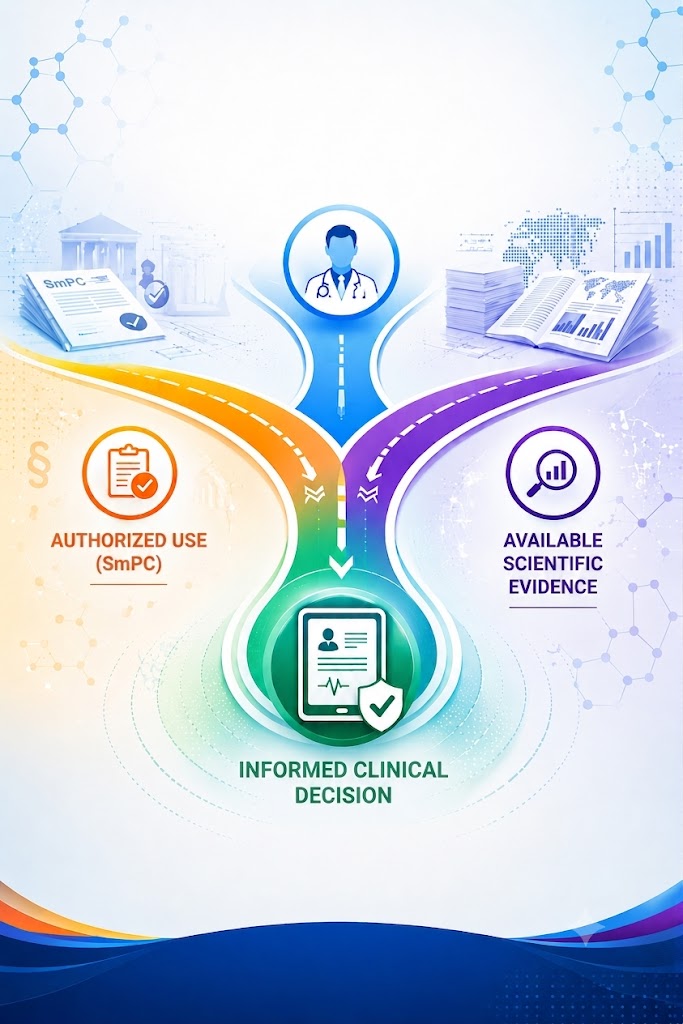
Managing off-label requests is one of the most sensitive areas within the Medical Information function, as it requires balancing access to accurate scientific information with full compliance with regulatory requirements and the principles of non-promotional communication.
Providing information about uses that have not been authorized by regulatory authorities requires a structured, documented, and evidence-based process. The objective is to respond appropriately to the healthcare professional’s question without encouraging or promoting unapproved uses.
What is an off-label request?
An off-label request is a request for information concerning the intended use of a medicinal product outside the terms of its marketing authorization.
For example, it may involve an unapproved therapeutic indication, a dosage different from the authorized one, a treatment duration not included in the approved labeling, a different route or method of administration, or use in a population not covered by the approved product information, such as pediatric patients, elderly patients, pregnant women, or patients with specific comorbidities.
In these situations, the use that is the subject of the request is not described, or is not fully supported, by the Summary of Product Characteristics (SmPC), which serves as the official reference document for the authorized conditions of use of the medicinal product.
Key principles for managing off-label requests
The management of off-label requests should be based on rigorous principles aimed at ensuring scientific accuracy, traceability, consistency with approved product information, and a clear separation from promotional activities.
A fundamental requirement is that the request must be unsolicited, meaning that it originates spontaneously from a healthcare professional or another legitimate requester and has not been induced, suggested, or stimulated by promotional or commercial activities. For this reason, it is important to document the original request, the context in which it was received, and the specific content of the question.
The response should clearly identify the off-label context and explicitly state that the use being discussed falls outside the authorized conditions of use. It should also clearly distinguish between information contained in the SmPC and information derived from other scientific sources.
Another key principle concerns clinical responsibility. Medical Information does not provide individual treatment recommendations or prescribing advice. Instead, it makes relevant and balanced scientific information available. The assessment of the benefit-risk profile for an individual patient and the final decision regarding potential use of the medicinal product remain the responsibility of the treating physician.
Responses should be proportionate to the question received, free from promotional emphasis, supported by reliable sources and, when appropriate, accompanied by disclaimers that explain the limitations of the available evidence and clarify that the described use is not authorized.
Challenges in managing off-label requests
Off-label requests present several challenges that can make their management particularly complex.
One of the main challenges relates to the availability and robustness of the evidence. Because the use falls outside the authorized conditions, information is generally not included in the SmPC and may instead be derived from preliminary clinical studies, retrospective analyses, case reports, real-world evidence, or inconclusive scientific literature. This requires careful evaluation of methodological quality, data volume, and the applicability of the findings to clinical practice.
A second critical aspect concerns how the response is formulated. Even when scientific evidence is available, communication should avoid unsupported conclusions, inappropriate comparisons, selective presentation of evidence, or wording that could be interpreted as encouraging off-label use.
Pharmacovigilance obligations must also be considered. If information concerning suspected adverse reactions, medication errors, misuse, overdose, exposure during pregnancy, or other safety-related situations emerges during the request, such information must be collected and managed according to company procedures and applicable regulatory requirements.
Why off-label requests may arise
Off-label requests can arise in clinical practice for a variety of reasons and do not necessarily imply inappropriate use of a medicinal product. They may reflect unmet medical needs, complex therapeutic situations, or areas where scientific evidence evolves more rapidly than regulatory updates.
Common examples include rare diseases, patient populations that are underrepresented in registration studies, patients with significant comorbidities, the absence of authorized therapeutic alternatives, or the availability of preliminary data from ongoing clinical trials or the scientific literature.
In such situations, the role of Medical Information is not to guide therapeutic decisions but to provide controlled, accurate, and documented access to the available information, in accordance with regulatory requirements and internal procedures.
A well-governed process therefore supports scientific exchange with healthcare professionals while preserving the distinction between reactive medical information and promotional activities.
Conclusions
The management of off-label requests is an activity with significant scientific, regulatory, and compliance implications, in which Medical Information plays a crucial role as an independent, reactive, and evidence-based function.
A proper approach requires that every response be relevant to the question received, accurate, balanced, documented, and consistent with the SmPC, clearly distinguishing between authorized uses and available information regarding unauthorized uses.
In this way, Medical Information contributes to ensuring appropriate access to scientific information, safeguarding the quality of medical-scientific communication, and reducing compliance risks while maintaining a clear separation between reactive information and product promotion.
References
- European Medicines Agency (EMA) – Good Pharmacovigilance Practices (GVP), Module VI: Management and Reporting of Adverse Reactions to Medicinal Products
- European Federation of Pharmaceutical Industries and Associations (EFPIA) – Code of Practice
- International Federation of Pharmaceutical Manufacturers & Associations (IFPMA) – Code of Practice
- European Medicines Agency (EMA) – Guidance on Scientific Information Exchange and Interactions with Healthcare Professionals
- European Commission – Directive 2001/83/EC (as amended) on Medicinal Products for Human Use
- Medicines for Europe – Guidance for Responding to Unsolicited Requests for Off-Label Information