
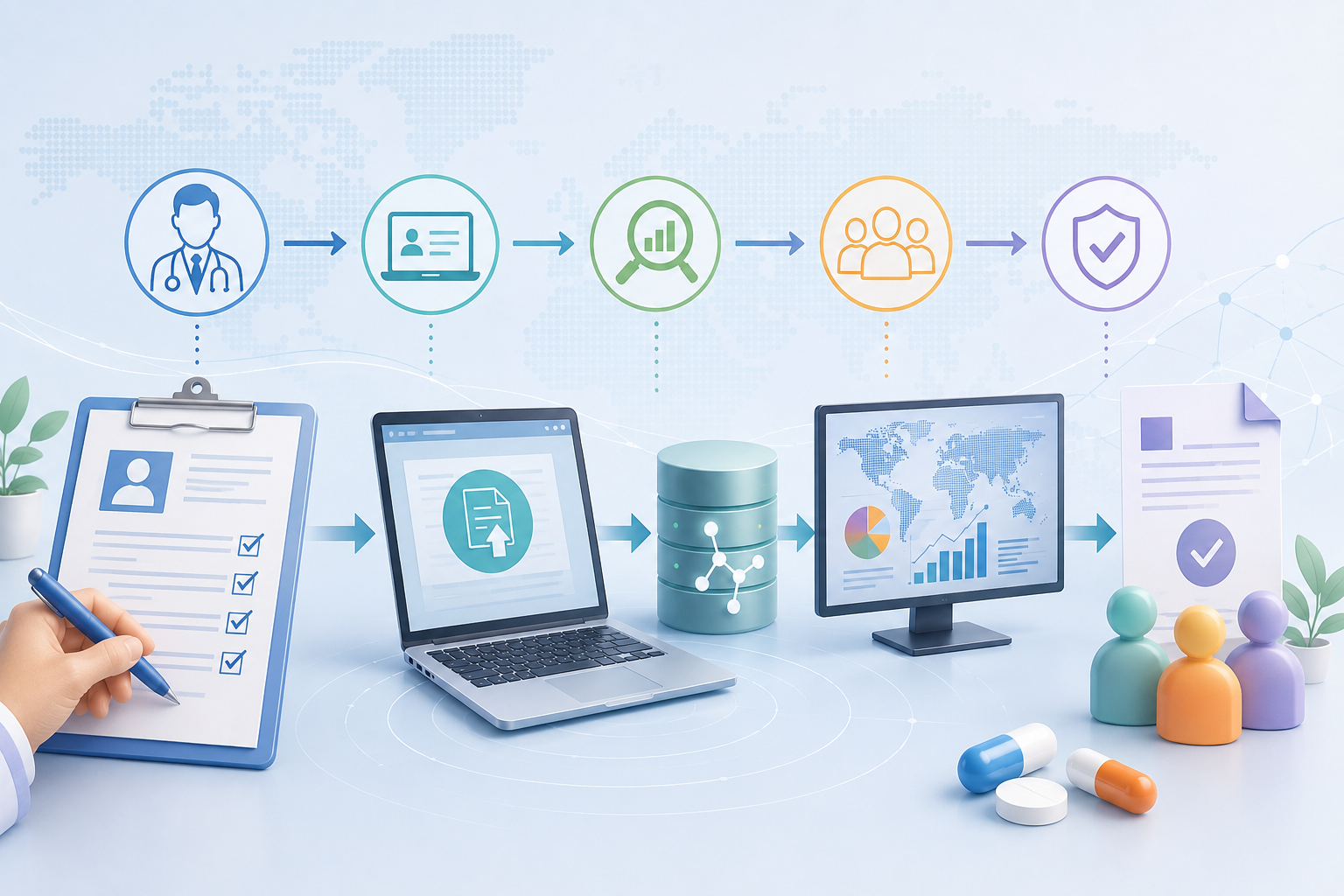
The safety of medicinal products requires continuous monitoring throughout the entire lifecycle of a drug, from the clinical development phase to the post-marketing period. The collection and evaluation of safety information are essential to promptly identify potential risks and ensure an increasingly appropriate and informed use of medicines.
In this context, the reporting of suspected adverse drug reactions plays a central role: it makes it possible to collect data that helps better understand the safety profile of medicinal products and supports the ongoing evaluation of their benefit–risk balance. Even individual cases, when considered together with other evidence, can contribute to the identification of signals that are relevant for the protection of public health.
What is a suspected adverse drug reaction
A suspected adverse drug reaction is defined as any unintended and undesired effect associated with the use of a medicinal product, for which a definite causal relationship has not necessarily been established, but for which there is at least a reasonable possibility of association.
To submit a report, it is not necessary to prove with certainty that the medicine caused the event: even a reasonable suspicion can provide a valuable contribution to pharmacovigilance activities.
Reports may concern events observed during the correct use of a medicinal product, but also particular situations such as medication errors, drug interactions, use outside the authorised indication, abuse, misuse or accidental exposure.
Essential information for a high-quality report
In order for a report to be properly assessed, it is important to collect information that is as complete and accurate as possible:
- description of the adverse reaction (symptoms, severity, outcome);
- suspected medicinal product (name, dose, duration of treatment);
- relevant patient information (age, sex, risk factors);
- time of onset (when the event occurred in relation to drug intake);
- concomitant treatments;
- relevant clinical conditions (medical history, comorbidities).
The completeness, accuracy and timeliness of the information collected are essential for a proper case evaluation, for better analysis of reported events and for the identification of potential safety signals. The quality of reports therefore contributes concretely to the continuous monitoring of the safety of medicinal products and to the adoption, when necessary, of appropriate measures to protect public health.
What happens after a report
Once collected, the report is evaluated and analysed as part of pharmacovigilance activities to further investigate the safety of the medicinal product.
The information provided is considered together with other available data in order to determine whether new elements may emerge that help better understand the risks associated with the medicine or any changes in its safety profile.
When relevant findings arise from this analysis, appropriate measures may be adopted, such as updating product information or introducing additional risk minimisation actions to promote a safer use of the medicine.
Conclusions
The reporting of suspected adverse reactions is a fundamental component of pharmacovigilance activities and contributes to the continuous monitoring of the safety of medicinal products throughout their entire lifecycle.
The quality of the information collected, together with the collaboration between healthcare professionals, patients, pharmaceutical companies and regulatory authorities, makes it possible to improve the understanding of the benefit–risk profile of medicines and to promote their safer and more appropriate use.
References
- ICH E2A – Clinical Safety Data Management: Definitions and Standards for Expedited Reporting
- AIFA – Pharmacovigilance and adverse reaction reporting
- World Health Organization (WHO) – Pharmacovigilance