
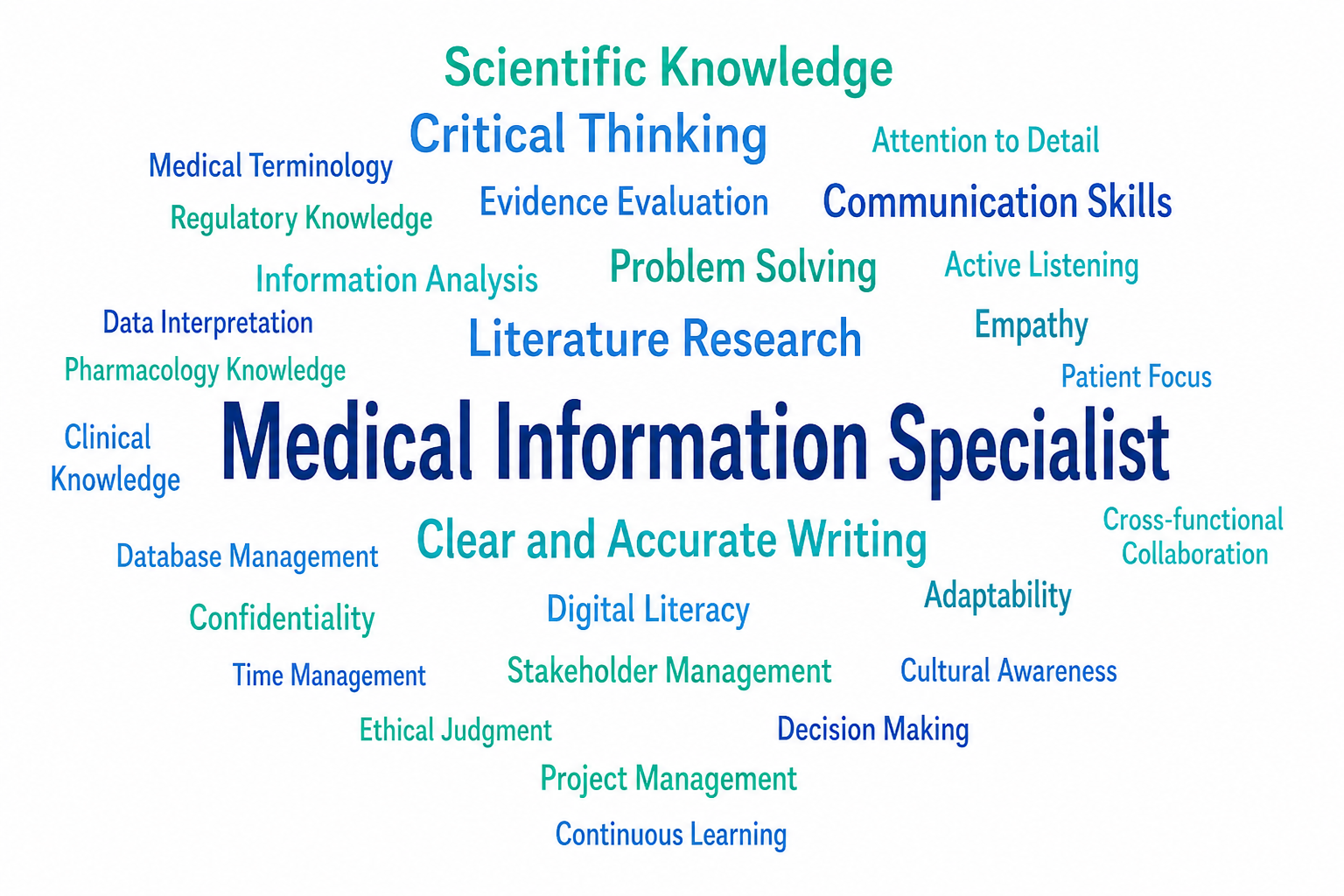
In the pharmaceutical industry, the Medical Information Specialist plays a central role in the management of scientific information related to medicinal products.
Working within a highly regulated environment, this professional supports the department’s information processes by providing responses based on scientific evidence and aligned with approved product information. Their contribution is essential to ensuring data quality and the appropriate use of medicines.
Required skills
The competencies required of a Medical Information Specialist reflect the complexity of the role. From a scientific perspective, a solid background in fields such as pharmacology, medicine, or life sciences is essential, together with the ability to interpret clinical studies, safety data, and scientific literature. The role goes beyond simply knowing the information; it requires the ability to critically analyze it and apply it to the specific context of each inquiry.
This scientific expertise is complemented by a strong regulatory understanding. A Medical Information Specialist must be familiar with the boundaries of approved information, such as the Summary of Product Characteristics (SmPC), and be able to develop responses that remain consistent with these approved sources.
Communication skills complete the profile. The ability to translate complex scientific content into clear and accurate information, while adapting the language to the intended audience, is essential for ensuring effective and non-promotional communication.
Daily activities
In daily practice, the work of a Medical Information Specialist is highly operational and dynamic. A significant portion of their time is dedicated to managing medical and scientific inquiries received from healthcare professionals and other stakeholders.
This involves analyzing the request, identifying the most appropriate sources—such as approved product information, internal databases, or scientific literature—and preparing a structured and documented response, often within defined timelines and using dedicated company systems.
Requests can vary considerably. For example, they may involve clarification regarding dosing regimens in specific patient populations, comparisons of efficacy data, or the management of potential drug interactions. In other cases, an apparently informational question may also include safety-related aspects, requiring a more detailed assessment and, when appropriate, the involvement of the pharmacovigilance function.
In addition to managing inquiries, Medical Information Specialists contribute to the maintenance and updating of standardized content, such as response documents and internal databases, helping to ensure consistency over time.
An evolving role
In recent years, the role of the Medical Information Specialist has evolved significantly. Increasingly complex scientific data, the growth of digital communication channels, and the rising volume of inquiries require a more structured and data-driven approach. In this environment, emerging technologies are also having a growing impact.
Artificial intelligence and automation tools are beginning to support certain activities, such as handling basic inquiries, conducting literature searches, and analyzing trends, thereby improving efficiency and helping manage increasing workloads.
However, the human contribution remains essential, particularly for the critical interpretation of data, the contextualization of information, and the development of complex responses. As a result, the Medical Information Specialist is evolving toward an increasingly specialized role in the management of scientific information.
Conclusions
Today, the Medical Information Specialist is a key professional in ensuring quality, consistency, and reliability in the management of scientific information.
In a continuously evolving environment, their contribution remains essential for supporting informed decision-making and promoting the safe and appropriate use of medicinal products.
References
- MAPS (Medical Affairs Professional Society) – Medical Information Standards and Frameworks
- MILE (Medical Information Leaders in Europe) – Principles Framework for Medical Information Services
- phactMI (Pharma Collaboration for Transparent Medical Information) – Medical Information Best Practices
- ABPI / PIPA – Guidance on Medical Information Services
- ICH Guidelines – International Standards for Quality, Safety and Efficacy
- Directive 2001/83/EC – Community Code Relating to Medicinal Products for Human Use
- Regulation (EC) No. 726/2004 – EU Procedures for Medicinal Product Authorisation