In the pharmaceutical industry, compliance with GxP (Good Practices) is one of the fundamental pillars for ensuring the quality, safety, and efficacy of medicinal products throughout their entire lifecycle. In a landscape characterized by increasing digitalization, global supply chains, and growing regulatory focus on data integrity, GxP has become a strategic requirement for organizations across the life sciences sector.
The main GxP regulations are based on standards issued by international regulatory authorities and organizations such as the EMA, FDA, and ICH, which provide harmonized guidelines to ensure quality and compliance on a global scale.
More than a set of rules, GxP constitutes an integrated framework built upon a systemic approach to quality and internationally recognized principles such as quality risk management and lifecycle management. In this context, regulatory compliance is not merely an inspection requirement but a strategic factor that directly influences operational sustainability and the maintenance of marketing authorizations.
A system covering the entire product lifecycle
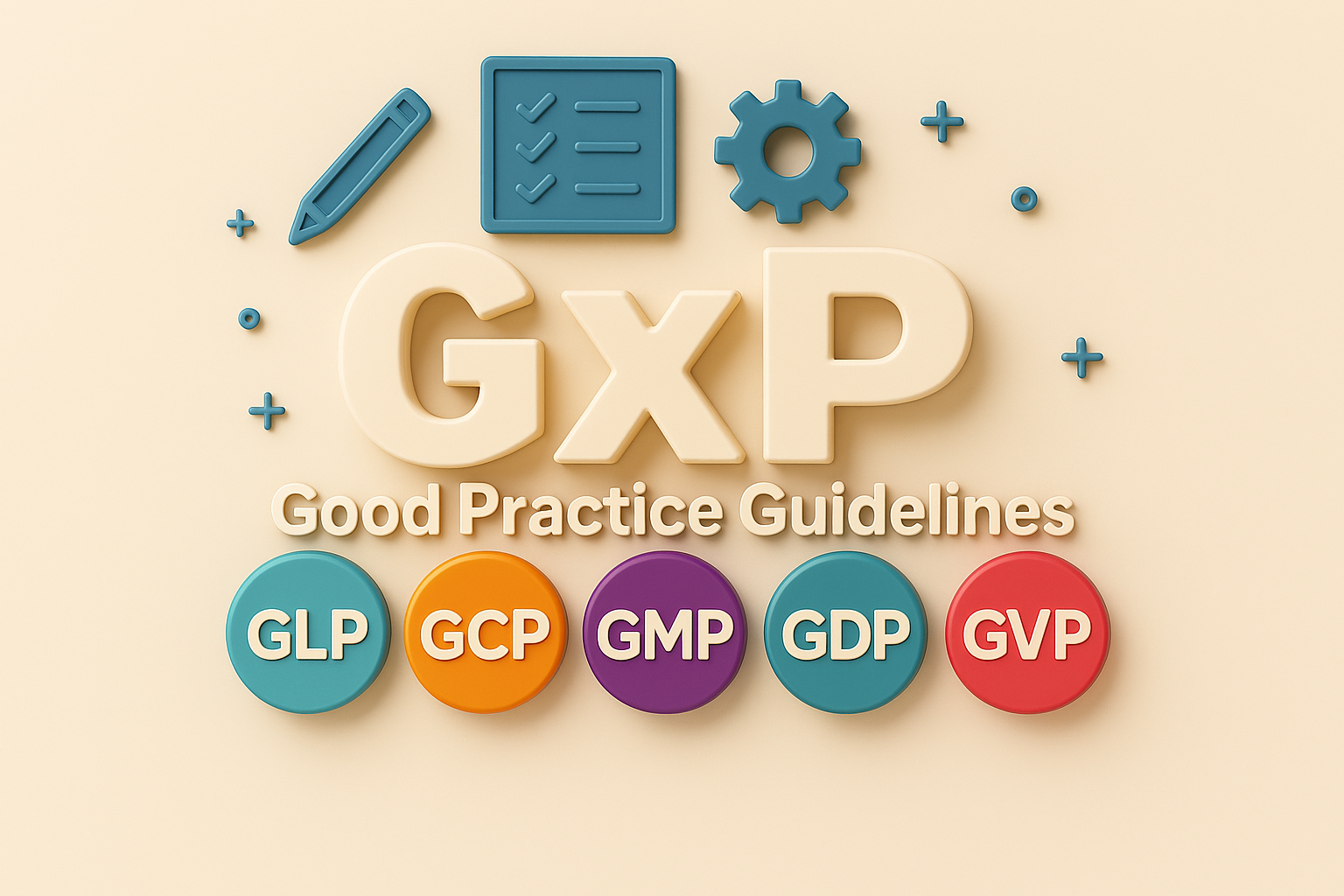
The GxP approach is designed to oversee every stage of a medicinal product’s regulatory journey through specific but interconnected quality standards. The acronym GxP refers to a family of “Good Practices,” where the “x” identifies the area of application.
Among the most important are:
- GLP (Good Laboratory Practice): Ensures the reliability of preclinical studies, guaranteeing that generated data are traceable, consistent, and reproducible.
- GCP (Good Clinical Practice): Governs clinical trials, with particular emphasis on participant protection and data integrity.
- GMP (Good Manufacturing Practice): Regulates manufacturing and quality control activities, ensuring product consistency and process compliance.
- GDP (Good Distribution Practice): Oversees supply chain activities, ensuring proper storage, transportation, and traceability of medicinal products up to the patient.
- GVP (Good Pharmacovigilance Practice): Regulates the continuous monitoring of medicinal product safety after market authorization.
This structure demonstrates that quality is not a single event but a continuous and dynamic process that accompanies a medicinal product throughout its operational lifecycle.
Key principles: data integrity, traceability, and a risk-based approach
Several cross-functional principles underpin the GxP framework and have become recognized industry standards.
Among these, data integrity plays a central role. Data must comply with the ALCOA+ principles (Attributable, Legible, Contemporaneous, Original, Accurate, as well as Complete, Consistent, Enduring, and Available), ensuring that all information remains reliable and verifiable over time.
At the same time, the traceability of activities is supported by robust documentation systems, including audit trails, version control, and structured change management processes through change control. In this context, the principle “if it isn’t documented, it didn’t happen” remains highly relevant.
Another key element is the adoption of a risk-based approach, aligned with ICH Q9, which enables organizations to focus resources on areas with the greatest impact, improving both control effectiveness and prioritization of activities. This approach is closely linked to the concept of lifecycle management, which requires a continuous and structured view of processes and systems throughout their lifecycle.
Quality systems and organizational culture
To achieve and maintain GxP compliance, pharmaceutical companies must implement a robust Pharmaceutical Quality System (PQS) aligned with the principles of ICH Q10.
An effective quality system should include structured processes for managing deviations, investigating root causes, and implementing Corrective and Preventive Actions (CAPA). These elements are essential for supporting continuous improvement and maintaining process reliability.
Beyond procedural and documentation requirements, regulatory authorities are increasingly focusing on an organization’s quality culture, understood as the widespread ownership of quality responsibilities at every level of the company—from senior management to operational personnel.
A mature quality culture promotes consistent decision-making, encourages proactive problem-solving, and helps ensure that compliance principles are embedded throughout the organization rather than being viewed solely as regulatory obligations.
Conclusions
GxP represents a comprehensive and continuously evolving framework that requires specialized expertise, structured governance, and strong integration between quality, regulatory affairs, and operations.
In an increasingly regulated and technologically advanced environment, GxP is far more than a collection of regulatory requirements. It is a key enabler of operational reliability, innovation, and patient protection.
Organizations that embrace an integrated approach to compliance—supported by mature quality systems, effective governance, and a culture of continuous improvement—are better positioned to meet both regulatory expectations and the competitive challenges of the global pharmaceutical industry.
References
- International Council for Harmonisation (ICH) – Q9 Quality Risk Management
- International Council for Harmonisation (ICH) – Q10 Pharmaceutical Quality System
- EudraLex Volume 4 – EU Guidelines for Good Manufacturing Practice (GMP)
- Good Distribution Practice (GDP) Guidelines – European Commission
- Good Pharmacovigilance Practices (GVP) – European Medicines Agency (EMA)
- FDA – 21 CFR Part 11 Electronic Records; Electronic Signatures
- OECD – Principles of Good Laboratory Practice (GLP)
- ICH E6(R3) – Good Clinical Practice (GCP)