
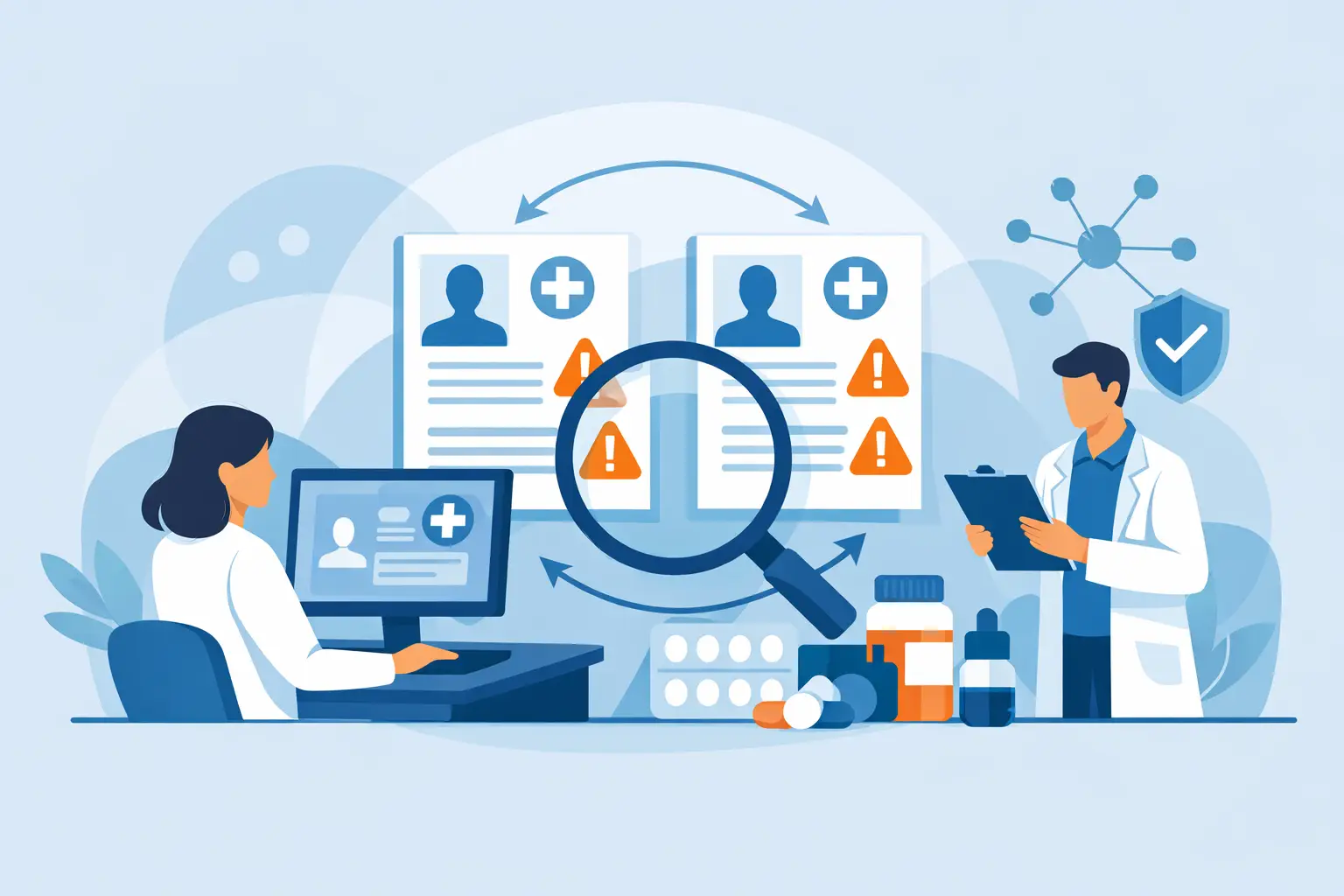
A suspected adverse reaction report may reach a company through different channels, at different times, and with varying levels of detail. Managing duplicate reports does not simply mean reducing the number of cases in a database. It means protecting the integrity of safety data, avoiding inconsistent evaluations, and maintaining documentation that can withstand audits and inspections.
The issue often arises within more complex processes. A healthcare professional may contact Medical Information, complete a website form, and report the same event to a sales representative. In another scenario, a patient may report a case to customer service while a healthcare professional reports the same event directly to the Marketing Authorization Holder. The information may be partially overlapping, inconsistent, or distributed across different systems. The accuracy of the final decision therefore depends on the quality of the reconciliation process, not solely on the ability to identify a textual match.
Why a duplicate is not simply repeated data
In pharmacovigilance, two apparently similar records are not automatically the same case. They may refer to different patients treated with the same medicinal product, the same patient experiencing separate events, or a follow-up to a previously collected case. Confusing these situations creates opposite risks: maintaining two independent cases may distort quantitative signal assessment, while incorrectly merging two cases may result in the loss of clinically relevant information.
The evaluation therefore requires distinguishing between a duplicate, a follow-up, and a related case. A duplicate is a report referring to the same patient and the same event, submitted multiple times or received from different sources. A follow-up adds or corrects information relating to an existing case. Related cases may involve the same patient, the same product, or the same reporter, but they describe independent events and must remain separate.
This distinction affects the management of the individual Individual Case Safety Report (ICSR), case coding, case narratives, data entry activities, and reporting outputs. It also affects the confidence that internal functions place in the safety database. An accurate repository supports more reliable analyses and faster decision-making when a potential safety issue emerges.
Managing duplicate reports using verifiable criteria
An effective process begins with standardized data collection. When the initial contact captures patient identifiers, event chronology, involved product, reporter information, and source channel in a structured manner, subsequent comparisons become more accurate. If this information remains within free-text notes, unclassified emails, or non-integrated systems, the risk of failing to identify duplicates increases significantly.
Identification should not rely on a single data point. The patient’s name or initials, age, sex, event onset date, therapeutic indication, batch number when available, suspected product, adverse event, reporter, and treatment location may collectively form a set of indicators. None of these elements, when considered in isolation, is always decisive. For example, matching age and an identical event are not sufficient grounds for merging two cases if other confirming information is missing.
It is useful to establish clear operational criteria that are approved and applied consistently. The procedure should define who performs the screening, at which stage of the workflow it occurs, which pieces of information must be compared, and when a second reviewer or pharmacovigilance manager should be involved. In complex cases, the rationale for the decision should be documented within the case file. Even the decision not to classify two records as duplicates should be traceable and reproducible.
The evaluation must also consider the source of the information. A report received from a healthcare professional and one received directly from a patient may describe the same clinical situation using different wording. Differences in terminology do not necessarily indicate different events. Similarly, a Medical Information request may contain minimum safety information that must be transferred and reconciled without losing the original context of the inquiry.
A workflow that preserves timelines and traceability
Duplicate management should be integrated into the case processing workflow rather than treated as an occasional downstream verification. A well-structured operating model first involves recording the report and verifying validity criteria, followed by a search for potential matches within the database and other relevant reporting channels. If a potential duplicate is identified, the processor compares the available clinical and identifying information, documents the outcome, and establishes the relationship with the primary case.
When duplication is confirmed, the record should not simply disappear. An audit trail must be maintained, documenting the origin of the second receipt, the date of receipt, the rationale for the assessment, and its link to the master case, in accordance with company procedures and applicable requirements. This traceability is essential when responding to quality reviews, regulatory requests, or reconciliation activities with licensing partners.
Timeliness remains critical. Duplicate evaluation should not delay case management or any reporting obligations. For this reason, predefined escalation procedures should be established for situations requiring clarification, additional information, or involvement of multiple functions. The operational principle is simple: uncertainty should be managed and documented, not left unresolved in an email inbox or personal spreadsheet.
In co-marketing, distribution, or licensing arrangements, procedures should also clarify how information is exchanged between the parties. Two organizations may receive the same case and assign different identifiers. Without a periodic reconciliation mechanism, the duplicate may persist within safety processes, affecting the consistency of shared safety evidence.
The role of Medical Information, Quality, and Information Systems
Duplicate reports often originate at the boundaries between functions rather than within the pharmacovigilance department itself. Medical Information, customer care, product complaint teams, Regulatory Affairs, commercial teams, and digital teams may all receive communications containing safety-related information. Every touchpoint should know when to transfer information to Pharmacovigilance, which information must be collected, and how original documentation should be preserved.
Regular training therefore represents a practical quality measure. The objective is not to turn every stakeholder into a case processor, but to enable them to recognize a potential report, avoid making inappropriate commitments to reporters, and activate the correct reporting pathway. Training based on realistic case scenarios is particularly useful for managing ambiguous situations, such as a healthcare professional who submits both a scientific inquiry and an adverse event report, or a patient who contacts the company again after already speaking with another department.
Safety systems can support duplicate detection through structured fields, matching algorithms, and alerts based on similar combinations of data. These tools are valuable, but they do not replace clinical and procedural judgment. An algorithm may identify numerous non-relevant matches or fail to recognize a duplicate when the available information is incomplete. System configuration must therefore be aligned with case volumes, incoming data quality, and the requirements defined within the quality management system.
Process metrics also deserve attention. The number of potential duplicates identified, assessment closure times, recurring causes of duplicate receipt, and reconciliation outcomes can reveal weaknesses within operational workflows. If duplicates frequently originate from a specific channel, the most effective solution may be reviewing the intake form, training program, or system integration rather than adding another manual control step.
When specialized external support is needed
For growing biotech companies, lean Medical Affairs teams, or organizations managing multiple products and partners, maintaining consistency in duplicate case assessment may require resources that are difficult to sustain internally. The value of specialized support lies not only in case processing capabilities but also in the availability of procedures, scientific expertise, and coordinated document control.
An outsourcing partner should integrate into the client’s governance model, respect roles, escalation timelines, and approval responsibilities, while ensuring appropriate training and quality standards for personnel involved. Integration between pharmacovigilance, Medical Information, and Quality Assurance reduces uncontrolled handoffs and improves consistency in the management of cases received through heterogeneous channels. This is the approach through which Eureka InfoMed supports life sciences organizations in activities involving significant regulatory responsibility.
Operational clarity is a safety measure in itself. Every report should have a traceable history, every decision should have a documented rationale, and every process step should have an identified owner. When these elements are in place, even a duplicate report becomes information managed through a structured process rather than a source of uncertainty within the pharmacovigilance system.
Sources
- European Medicines Agency (EMA). Good Pharmacovigilance Practices (GVP), Module VI – Collection, Management and Submission of Reports of Suspected Adverse Reactions to Medicinal Products.
- International Council for Harmonisation (ICH). E2D Post-Approval Safety Data: Definitions and Standards for Expedited Reporting.
- International Council for Harmonisation (ICH). E2B(R3) Electronic Transmission of Individual Case Safety Reports (ICSRs).
- European Medicines Agency (EMA). Good Pharmacovigilance Practices (GVP), Module IX – Signal Management.