
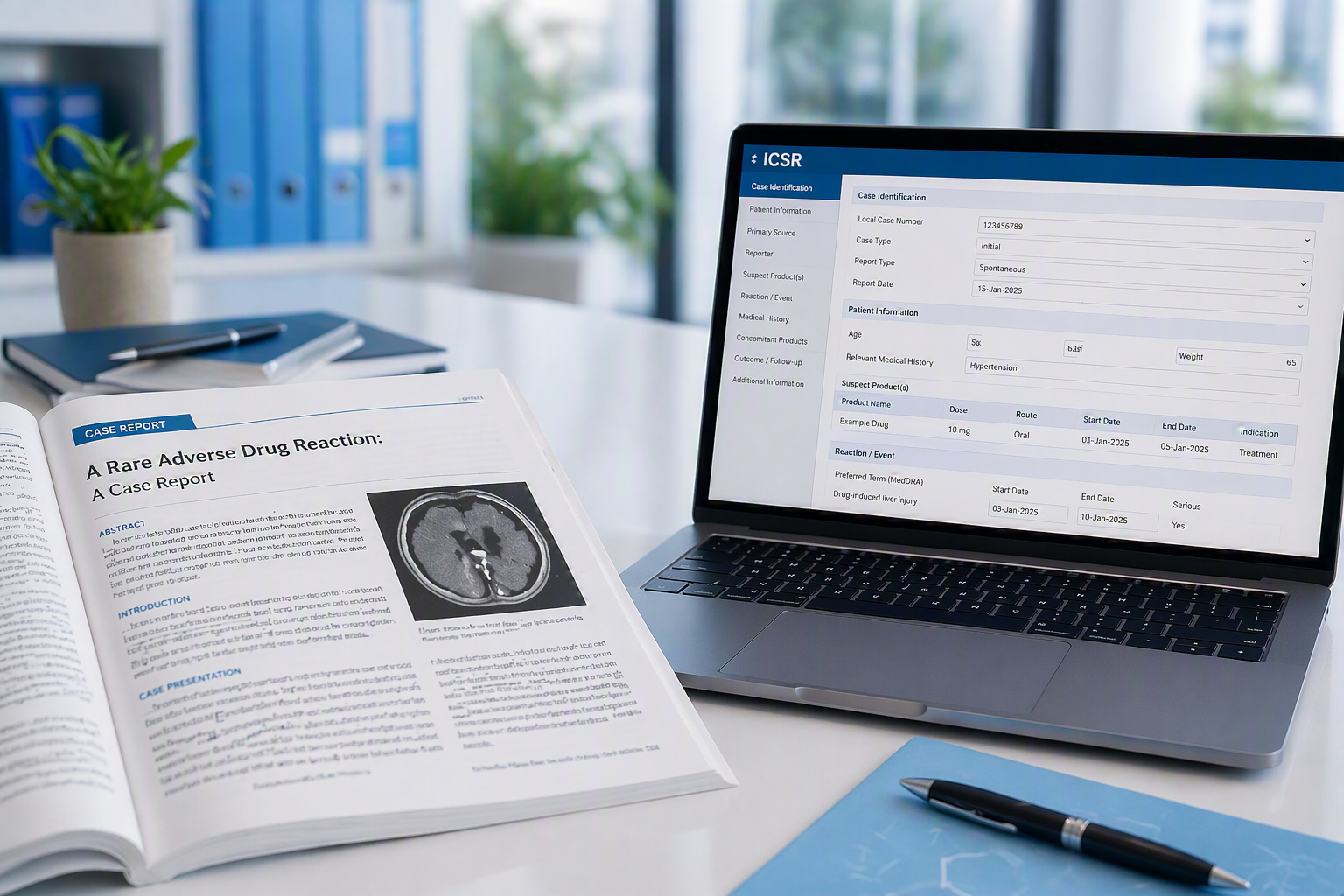
Pharmacovigilance relies on the collection and analysis of safety information generated during real-world use of medicinal products. A significant portion of our knowledge about medicine-related risks comes from the observation of individual cases. Over time, these observations have helped identify previously unknown adverse reactions and better characterize known safety concerns.
In this context, case reports and Individual Case Safety Reports (ICSRs) are distinct yet complementary tools. Both describe events observed in individual patients, but they serve different purposes and are used in different ways.
What is a case report?
A case report is a scientific publication that provides a detailed description of an individual clinical case observed by a healthcare professional.
Typically, a case report is written when the case presents particularly interesting features, such as a rare adverse reaction, unexpected drug interaction, the use of a medicine in a specific patient population, or an event that may suggest a previously unrecognized safety issue.
The value of a case report does not lie in proving a causal relationship between a medicine and an adverse event. Instead, it helps generate hypotheses, draw the attention of the scientific community to a potential issue, and provides a basis for further investigation.
What is an ICSR?
An Individual Case Safety Report (ICSR) is the standardized format used in pharmacovigilance to document, record, and transmit information related to a suspected adverse reaction observed in a patient.
Unlike a case report, which has primarily scientific and educational purposes, an ICSR is a structured regulatory report based on internationally recognized standards.
Its purpose is to collect and standardize the information required for case assessment and analysis within pharmacovigilance systems.
For a report to be considered a valid ICSR for regulatory purposes, it must contain four minimum criteria:
- an identifiable patient;
- an identifiable reporter;
- at least one suspected medicinal product;
- at least one suspected adverse reaction.
When available, additional information is also collected, including concomitant medications, medical history, clinical conditions, event progression, outcome, and other data relevant to medical and scientific evaluation.
The information is coded using internationally recognized standards, such as MedDRA for adverse event terminology, ensuring consistency and comparability across different pharmacovigilance systems.
Although they are different tools, case reports and ICSRs can be closely connected. For example, a case published in scientific literature may be identified through literature monitoring and subsequently processed as an ICSR within pharmacovigilance systems.
How are they used in pharmacovigilance?
ICSRs represent one of the most important data sources used in pharmacovigilance activities.
Reports may originate from healthcare professionals, patients, pharmaceutical companies, clinical trials, and scientific literature. After receipt, each report undergoes an assessment to verify its validity, completeness, and overall data quality.
The validation process confirms the presence of the minimum criteria required for regulatory reporting. Once validated, the case is recorded, coded according to applicable standards, and processed within the pharmacovigilance system.
During case management, available information is reviewed to better understand the clinical context, including:
- completeness of the available information;
- temporal relationship between drug exposure and the event;
- clinical plausibility of the association;
- presence of potential confounding factors;
- patient characteristics;
- availability of similar previously reported cases.
After processing, ICSRs are entered into company pharmacovigilance databases, when applicable, and transmitted to regulatory authorities according to the timelines and requirements established by current regulations.
In Europe, suspected adverse reaction reports are submitted to EudraVigilance, the European database managed by the EMA. Internationally, safety information may also be available through systems such as FAERS in the United States and VigiBase, the World Health Organization’s global database managed by the Uppsala Monitoring Centre.
The true value of an ICSR emerges from the analysis of large numbers of cases collected from different sources and countries. This aggregated analysis makes it possible to identify patterns and potential associations that may not be evident from an individual case.
For this reason, ICSRs are essential for signal detection and, more broadly, for signal management, supporting the continuous evaluation of the benefit-risk profile of medicinal products.
Their contribution to medicine safety
Case reports and ICSRs both contribute to expanding knowledge about the safety profile of medicinal products, although they do so in different ways.
Case analysis can support the identification of new risks, the reassessment of known safety concerns, and the ongoing monitoring of medicine benefit-risk profiles. When required, the resulting evidence may support updates to the Summary of Product Characteristics (SmPC), the introduction of new warnings, or the implementation of additional risk minimization measures.
In this way, initially isolated clinical observations can be transformed into valuable knowledge that supports safer medicine use and protects public health.
Conclusion
Case reports and ICSRs are different but complementary tools. Case reports communicate clinical observations through scientific literature, while ICSRs organize safety information in a standardized regulatory format.
Their value extends far beyond individual cases. Through data aggregation and comparison with other sources of evidence, they strengthen benefit-risk monitoring and contribute to protecting public health.
Sources
- European Medicines Agency (EMA). Good Pharmacovigilance Practices (GVP), Module VI – Collection, Management and Submission of Reports of Suspected Adverse Reactions to Medicinal Products.
- International Council for Harmonisation (ICH). E2D(R1) Post-Approval Safety Data: Definitions and Standards for Management and Reporting of Individual Case Safety Reports.
- International Council for Harmonisation (ICH). E2B(R3) – Electronic Transmission of Individual Case Safety Reports.
- European Medicines Agency (EMA). EudraVigilance System Overview.
- World Health Organization (WHO) – Uppsala Monitoring Centre (UMC). VigiBase and Signal Detection Resources.
- European Medicines Agency (EMA). Good Pharmacovigilance Practices (GVP), Module IX – Signal Management.
- European Medicines Agency (EMA). GVP Module IX Addendum I – Methodological Aspects of Signal Detection from Spontaneous Reports of Suspected Adverse Reactions.
- Hauben M, Aronson JK. Defining “Signal” and Its Subtypes in Pharmacovigilance Based on a Systematic Review of Previous Definitions. Drug Safety.
- European Medicines Agency (EMA). Good Pharmacovigilance Practices (GVP), Module X – Additional Monitoring.